Where the aerosol
leaves the building.
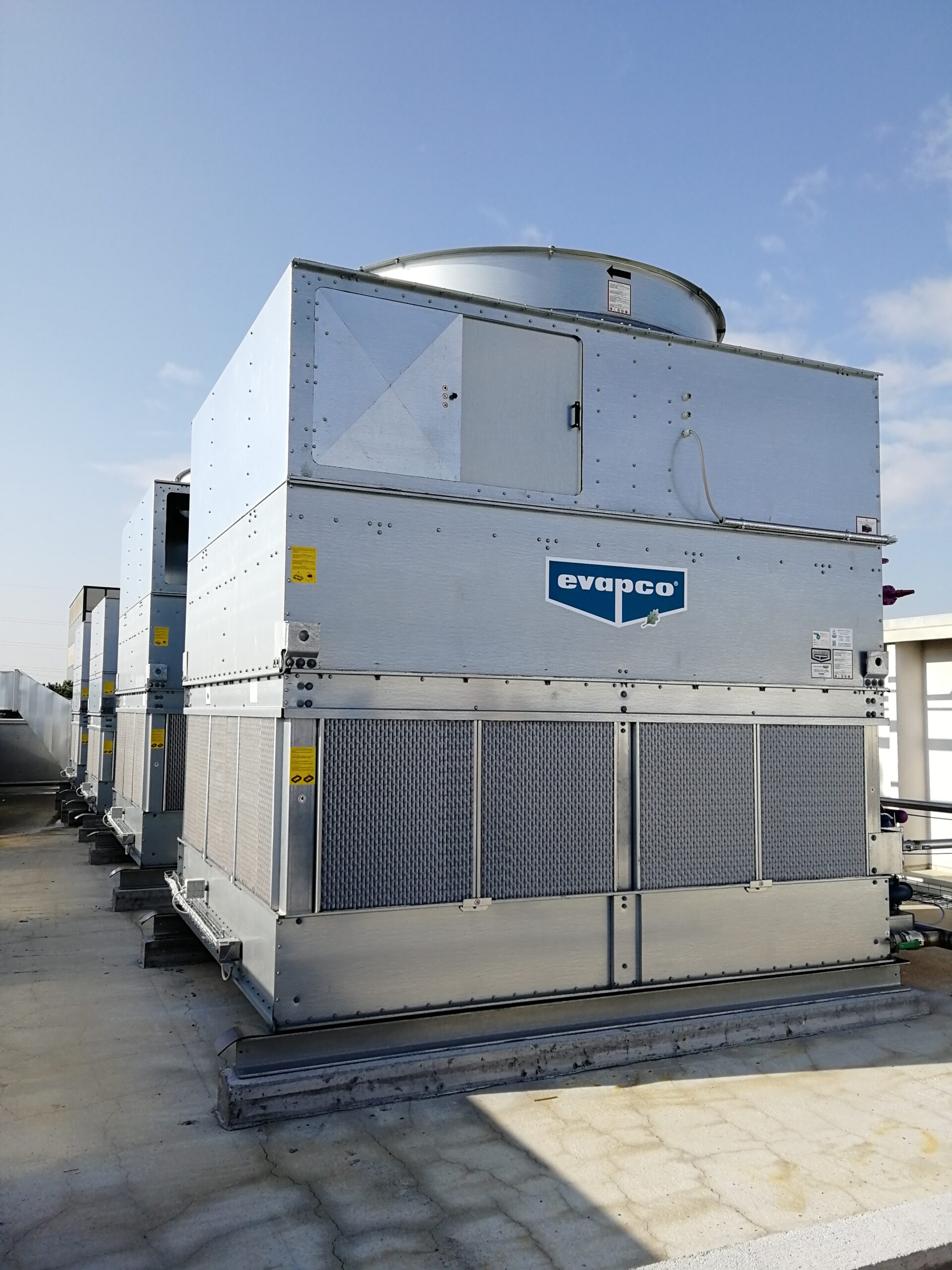
A cooling tower disperses thousands of cubic metres of microdroplet-laden air into the atmosphere, which the wind can carry for kilometres. It is the only plant component capable of turning an internal problem into a community outbreak: this is why the treatment cannot be limited to maintaining a biocide residual.
Warm water, air,
enormous surfaces
and light.
The fill pack offers tens of square metres of wetted surface at temperatures between 25 and 35 °C, with a continuous supply of oxygen, dust and nutrients drawn in from the surroundings. It is the ideal environment for biofilm, and biofilm is the home of Legionella.
- Towers are subject to notification and registration and are among the at-risk systems in the 2015 national guidelines
- Continuous biocide acts on the water, not on the adhered biofilm: the count returns as soon as dosing stops
- Organic deposit reduces heat transfer and pushes up the electricity consumption of the chiller
- Corrosion, scaling and microbiological fouling feed one another
Removing the house,
not just the tenants.
Probiotic treatment for cooling towers does not attack the pathogens: it removes their substrate. The selected strains metabolise the organic deposit that forms the matrix of the biofilm and occupy the surface permanently, making it unavailable for recolonisation.
Colonisation
In the first phase the system introduces a high probiotic load into the circuit. The strains spread over the fill pack, basin, pipework and wetted surfaces, beginning to break down the organic matrix of the existing biofilm enzymatically.
Probiotic action
Breaking down the matrix progressively releases the adhered deposit and makes it available for degradation. The freed surface is taken over by the probiotics themselves: space and nutrients stop being available to Legionella and Pseudomonas.
Maintenance
A low-concentration maintenance dose preserves the balance achieved. The system stays stable over time with no escalation of dosing and no development of resistance, because the mechanism is competitive and not biocidal.
What you gain,
beyond compliance.
Probiotic treatment is justified on health risk, but it pays for itself on the efficiency of the plant.
Stable control of Legionella and Pseudomonas
By acting on the biofilm and not only on the water, the analytical result holds over time instead of swinging between one treatment and the next.
Progressive biofilm removal
The organic deposit is metabolised continuously, with no plant shutdowns and no extraordinary mechanical work.
Recovered energy efficiency
Clean heat transfer surfaces mean a better thermal delta and lower electricity consumption by the chiller: a benefit measurable on the bill.
Fewer biocides in circulation
Reducing the chemical load lowers product costs, risks for operators and the impact of the discharge.
Less blowdown and less make-up water
Better circuit water quality allows more favourable concentration cycles, with direct water savings.
Materials preserved
Less corrosion and less scaling: the service life of the fill pack and the pipework is extended.
Operator safety
Biodegradable, non-toxic products reduce handling risks compared with high-concentration biocides.
Verifiable result
Scheduled sampling, the trend of the count over time and circuit parameters document the effectiveness of the treatment.
Industrial circuits
and car washes.
The same logic applies to every open or semi-open circuit in which water recirculates at favourable temperatures and accumulates organic load.
- Process cooling circuits and heat exchangers
- Collection, settling and reuse tanks at car washes
- Industrial treatment plants and storage tanks for recirculated water
- Fire mains and circuits with long periods of stagnation
- Humidification plant and adiabatic systems

Tell us about your system.
We design safe water and air.
Technical consultancy, risk assessment, bespoke design and tailored quotations for healthcare facilities, hotels, industry, public bodies, resellers and distributors all over the world.