The right dose,
only when
the water flows.
Fixed-rate dosing wastes product when consumption is low and under-doses at the peaks, exactly when more would be needed. Proportional dosing ties every single injection to the volume that has actually passed, as measured: the concentration stays constant whatever the system does.
A building’s consumption
is never constant.
In a hotel the morning peak and the night differ by an order of magnitude. In a hospital the flow rate changes from ward to ward and from shift to shift. A pump that always injects the same quantity per unit of time produces, in the same system, concentrations that swing continuously.
The result can be read in the test reports: residual below the useful threshold in some time bands — and therefore no real protection — and above the regulatory limit in others, with higher product costs, unwanted by-products and accelerated corrosion of the network materials.
Five links,
a single chain
of measurement and control.
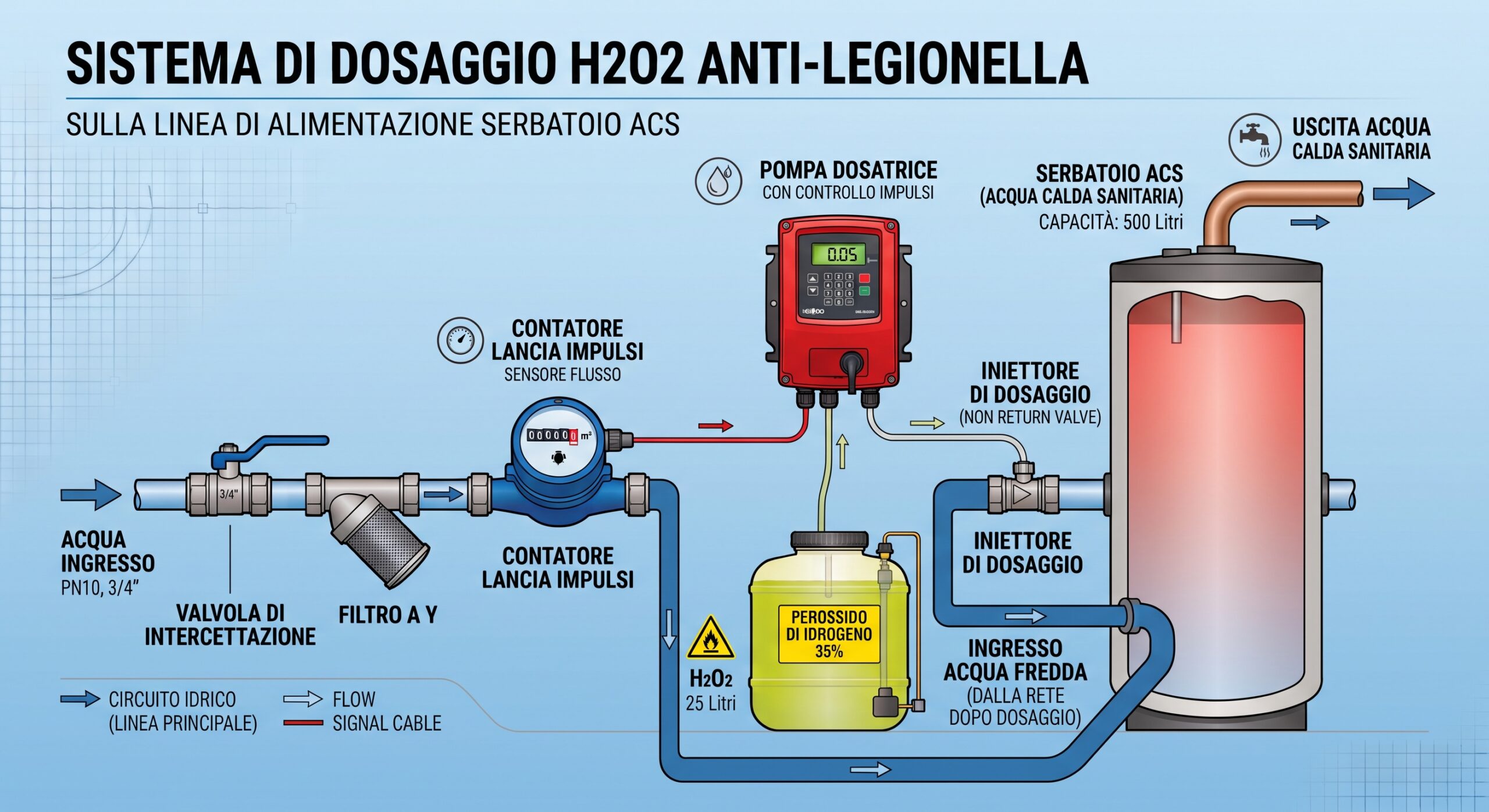
The system is not a pump: it is a closed loop in which the volume measurement commands the injection and the residual measurement corrects that command.
Measurement of the volume passed
A volumetric meter or a flow meter installed on the line generates an electrical pulse every time a defined quantity of water passes — one litre or ten litres, for example. The flow rate is not estimated: the litres actually delivered are counted, one by one, even when the draw-off lasts only a few seconds.
Electronic processing
The controller converts the pulses into injection commands, applying the concentration set by the operator, expressed in ppm or in millilitres per cubic metre. The electronics hold the pulses received during the peaks in memory and work through them without losing any, so the total dose stays exact even when the instantaneous flow rate exceeds the capacity of the pump.
Calibrated injection
A dosing pump — peristaltic or solenoid-driven diaphragm — delivers a calibrated volume of product at every command, through an injection valve with a non-return device that prevents any backflow towards the tank. The calibration is verified on site with a volumetric test, not assumed from the rating plate.
Residual verification
A probe installed downstream measures the actual residual of active substance continuously and closes the loop: if the value drifts from the reference, the controller corrects the dose. It is the step that distinguishes proportional dosing from simply timed dosing.
Logging, alarms and reports
The system records the cubic metres treated, the litres of product used and the measured residual, and signals under- and overdosing, no flow, minimum tank level and pump failure in real time. The reports go into the maintenance log and make it verifiable, month by month, that the treatment was actually delivered.
Why it pays off,
financially too.
Constant concentration
The residual stays in the useful window at any flow rate: no gap in protection at peak hours, no exceedance in the quiet hours.
Less product used
Injection is in proportion to the litres actually delivered: idle dosing while the system is at rest disappears, and in annual consumption that counts for more than people think.
Demonstrable compliance
Treated volumes, delivered doses and measured residuals are logged and downloadable: delivery of the treatment becomes a figure, not a statement.
Faults you see straight away
An empty tank, a failed pump, an out-of-range probe or abnormal consumption raise an immediate alarm, instead of surfacing at the next sampling.
Materials preserved
Avoiding concentration peaks reduces corrosion, disinfection by-products and stress on the materials of the internal network.
Integrates with the system
Consumption data and alarms can be brought into the management software, alongside temperature readings and analytical results.
The parameters we
decide together.
A dosing system is not chosen from a catalogue: it is sized on the figures of the network. Before quoting, we collect the data that determine the technology, the size of the pump and the position of the injection point.
- Peak and average flow rate of the line to be treated
- Volume of the downstream network and available contact time
- Materials of the internal network and their compatibility with the active substance
- Target residual and minimum residual guaranteed at the least favoured point
- Intended use of the water and applicable regulatory limits
- Position of the injection point, the static mixer and the control probe
Tell us about your system.
We design safe water and air.
Technical consultancy, risk assessment, bespoke design and tailored quotations for healthcare facilities, hotels, industry, public bodies, resellers and distributors all over the world.