The WSP: from analytical
compliance to risk-based
prevention.
The Water Safety Plan (WSP) is the model recommended by the WHO and adopted in Directive (EU) 2020/2184 and Legislative Decree 18/2023. It shifts control from downstream verification, the compliant sample, to prevention along the whole chain, right to the last mile: the building’s internal water system.
A management system,
not a document.
The WSP applies the same logic as HACCP to water: identify the hazards and hazardous events along the entire chain, assess their risk, define control measures with critical points and operational limits, monitor them, correct and verify. It is not a one-off formality: it is a cycle that lives on over time.
With Legislative Decree 18/2023 the approach extends to the internal water distribution systems of priority buildings, with specific regard to lead and Legionella. Responsibility falls on the GIDI, the internal water distribution system operator: the owner, holder or manager of the building.
Risk assessment and management in internal distribution systems must begin to be implemented by 12 January 2029, be verified annually and extensively reviewed every six years (Directive (EU) 2020/2184, art. 10; Legislative Decree 18/2023).

The five building
priority classes.
ISTISAN Report 22/32 defines five classes (A-E) in decreasing order of complexity, based on the vulnerability of those exposed, volumes supplied, the size and age of the network, seasonality, stagnation phenomena and the sustainability of the measures. Classes A-D correspond to priority buildings and ships; class E covers the other public and private buildings and blocks of flats.
Healthcare, social care and care home facilities providing inpatient accommodation
Identification of the GIDI. Full WSP for the internal water distribution system, with particular regard to lead and Legionella, ensuring as a minimum the checks required by current legislation.
Multidisciplinary team chaired by the team leader, with professionals experienced in monitoring, sampling and analysis.
Healthcare and care facilities without inpatient accommodation, including rehabilitation centres, outpatient clinics and dental practices
Identification of the GIDI. Self-monitoring plan for the internal water systems with minimum monitoring of lead, Legionella and L. pneumophila.
The GIDI, supported where necessary by multidisciplinary expertise.
Hotels and hospitality venues, prisons, ships, stations, airports; public and contract catering, workplace and school canteens
Self-monitoring plan for the internal water systems, where appropriate incorporated into the risk assessment document (DVR) under Legislative Decree 81/08 or into the HACCP plan, with minimum monitoring of lead, Legionella and L. pneumophila.
The GIDI supported by multidisciplinary expertise; in catering the role may be taken by the food business operator (OSA).
Barracks, schools with sports facilities, campsites, gyms, sports, fitness and wellness centres, other premises in collective use
Identification of the GIDI. As a minimum, a hygiene verification plan for water intended for human consumption with minimum monitoring of lead and Legionella. A self-monitoring plan is recommended.
The GIDI supported where necessary by multidisciplinary expertise.
Other public and private buildings: blocks of flats, homes, offices, schools, commercial premises
Site-specific actions are not generally required, other than the recommendation to check for lead. For large buildings, complex networks or prolonged exposure of vulnerable people, a monitoring plan comparable to class B or C is recommended, together with two-yearly Legionella monitoring where appropriate.
The owner or manager of the building.
Summary drawn from Table 2 of ISTISAN Report 22/32, Guidelines for the assessment and management of water safety risk in the internal water distribution systems of priority and non-priority buildings and of certain ships pursuant to Directive (EU) 2020/2184. The duties are subject to the provisions of Legislative Decree 18/2023.
Who falls within the definition
of a priority building.
Legislative Decree 18/2023 defines priority buildings as large premises in non-domestic use, in particular public use, with numerous users potentially exposed to water-related risks.

Hospitals and healthcare facilities

Care homes and childcare facilities

Schools and educational institutions
Hospitality venues, restaurants and bars

Sports and shopping centres

Leisure and recreational facilities

Prisons and campsites

Ships, stations and airports
The stages of developing
and implementing a WSP.
The process follows the structure set out in ISTISAN Report 22/32 and the WHO principles. Each stage produces auditable documentation, which also serves as the operator’s evidence of due diligence.
Preparatory stages
Setting up the multidisciplinary WSP team, defining roles and responsibilities, establishing the document archive and the record-keeping system.
Description of the water system
Survey and functional schematic of the network: point of delivery, storage, hot water generation and distribution, return circuits, materials, age, outlets, critical users, temperature and flow data.
Identification of hazards and hazardous events
Systematic mapping of what can go wrong: stagnation, dead legs, out-of-range temperatures, lead contamination, accidental ingress, failures, system shutdowns, maintenance works.
Risk assessment and control measures
Semi-quantitative analysis, in our method using an FMEA approach, weighing severity, probability and detectability, and matching each event with the existing control measures and their actual effectiveness.
Improvement plan
Engineering, management and organisational measures prioritised by cost/benefit ratio, with owners, timescales and completion indicators.
Operational monitoring
Continuous and scheduled checks on the parameters that govern the risk: temperatures, return circuits, flushing, residual disinfectant, with operational limits and alert thresholds.
Corrective actions and management procedures
Written procedures for normal, exceptional and emergency conditions: what to do, who does it, by when, how it is recorded.
Verification plan
Verification sampling and analysis at accredited laboratories, internal audits, review of compliance and of the plan’s overall effectiveness.
Communication, training and review
Communication plans for users and authorities, staff training and qualification programmes, periodic review of the WSP, annually and with an extensive review every six years.
Why the risk
concentrates in
the last mile.
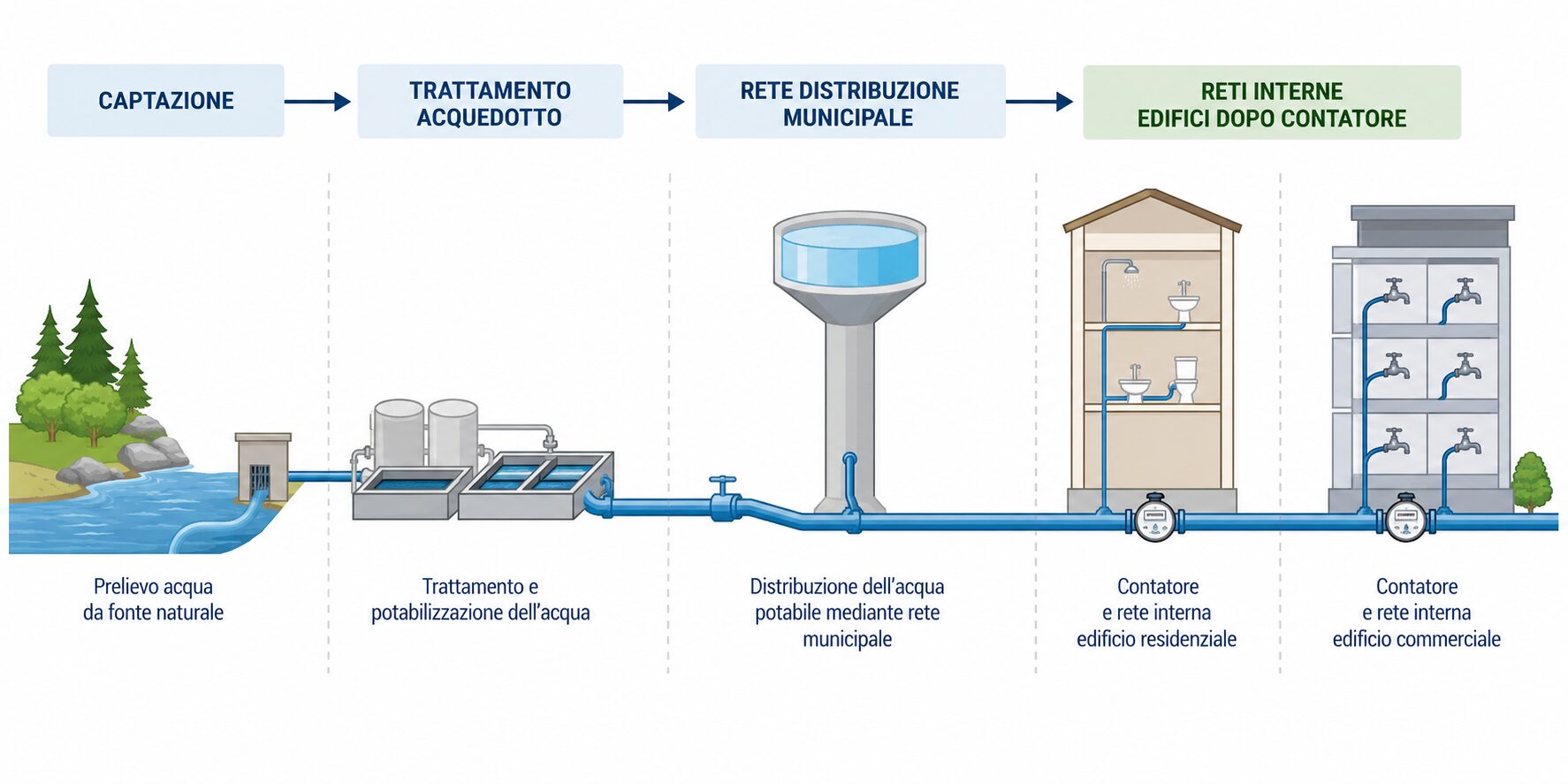
The water arriving at the point of delivery is, in the vast majority of cases, compliant. It is downstream, in the building’s internal network, that the conditions generating the risk are concentrated: long residence times, intermediate temperatures, mixed materials, little-used end sections, undocumented maintenance work.
- Lead. The parameter value remains 10 µg/L until 12 January 2036; from that date compliance will mean 5.0 µg/L at the point of delivery. Lead pipes, alloys and solders must no longer be used or installed.
- Legionella. It is the key parameter in Annex I part D of Directive (EU) 2020/2184 for the internal systems of priority buildings, alongside lead.
- Materials in contact. From 2036 only compliant materials and reagents (ReMaF), authorised by CeNSiA and registered in the AnTeA system, may be placed on the market: they must not indirectly encourage microbial growth.
- Antibiotic resistance. Internal water networks are recognised as an environmental reservoir of resistance genes: managing biofilm matters well beyond the single pathogenic species.
Regulatory and scientific references
- Directive (EU) 2020/2184, quality of water intended for human consumption
- Legislative Decree no. 18 of 23 February 2023 (Official Gazette no. 55 of 6 March 2023)
- ISTISAN Report 22/32, Italian National Institute of Health (ISS)
- State-Regions Agreement of 7 May 2015, no. 79/CSR
- Legislative Decree 81/2008, Title X, biological agents
- WHO, Water Safety Plan Manual
The questions we are asked
most often about the WSP.
Who is the GIDI and what are their responsibilities?
The internal water distribution system operator is the party, owner, holder or manager of the building, premises, ship or complex of buildings, responsible for managing the network downstream of the point of delivery. They must be formally identified and are accountable for carrying out the risk assessment and management, the minimum monitoring and the documentation.
What is the difference between a WSP, a self-monitoring plan and a verification plan?
They are three levels of depth, proportionate to the risk. The WSP (class A) is the complete system, with a multidisciplinary team, extensive hazard analysis, control measures, operational monitoring and verification. The self-monitoring plan (classes B and C) applies the same principles in simplified form and can be integrated into the risk assessment document (DVR) or the HACCP plan. The hygiene verification plan (class D) is essentially monitoring of lead and Legionella with on-site measurements and sampling.
Does the WSP replace the Legionella risk assessment?
No, it absorbs and extends it. The Legionella risk assessment required by the 2015 Italian national Legionella guidelines remains a standalone duty tied to public health and workplace safety; the WSP incorporates it into a wider management system that also covers lead, materials in contact, continuity of supply and other parameters. In practice we design a single documentary structure that satisfies both regulatory frameworks, avoiding duplication.
How long does it take to implement a WSP?
It depends on the complexity of the network and the quality of the existing documentation. For a medium-sized building with drawings available, the survey and risk assessment stage typically takes from a few weeks to a couple of months; for a hospital site with several blocks it takes longer. The improvement plan then unfolds over a multi-year horizon, with priorities set according to risk.
What happens if you don’t comply?
In administrative terms, Legislative Decree 18/2023 and sector legislation provide for a system of penalties; in workplace safety terms, failure to assess biological risk exposes the employer to the penalties under Legislative Decree 81/2008. The most significant aspect, however, remains civil and criminal liability in the event of personal injury: in court, the evidence of due diligence is the documentation of the management system.
Tell us about your system.
We design safe water and air.
Technical consultancy, risk assessment, bespoke design and tailored quotations for healthcare facilities, hotels, industry, public bodies, resellers and distributors all over the world.